When a Kenyan lot shows up, you get a grade, an outturn number and a cup score. It rarely comes with a variety. That is strange, because the Kenyan coffee varieties are the main reason the crop tastes the way buyers pay for, and they are also the main reason a field's output can change character from one harvest to the next. According to a study of improved varieties held at Embu University's repository, Kenya produces mainly arabica from five commercial cultivars: three traditional ones, SL28, SL34 and K7, and two newer disease-tolerant ones, Ruiru 11 and Batian.
Kenyan field reports and international trial catalogues disagree on several points below. Yield and cup stand out. No source gives a price for any variety. The auction does not price by variety at all.
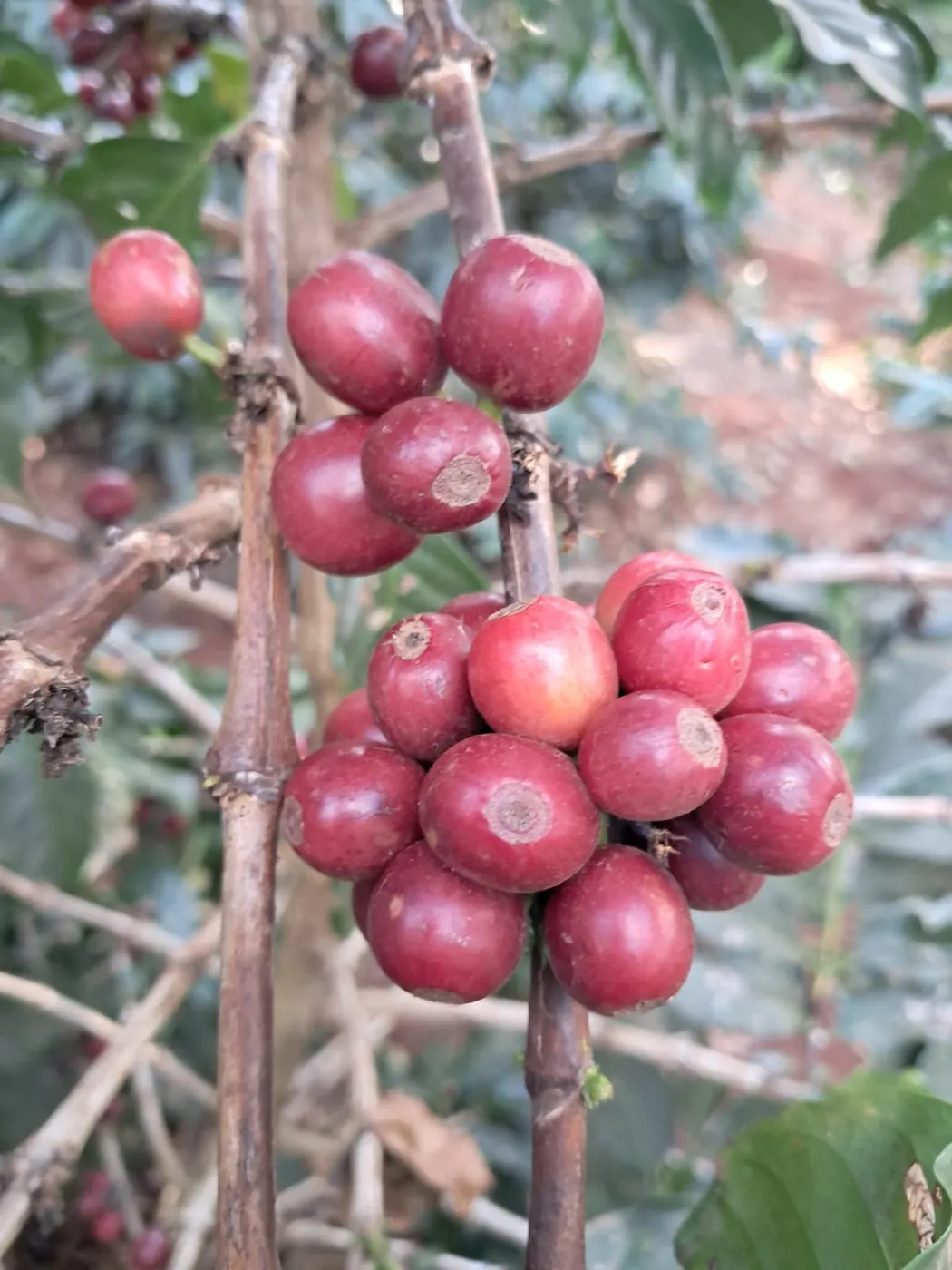
A single tree at Kabete, 1935
SL28 has an origin story that is unusually well documented. The World Coffee Research catalogue entry for SL28 says A.D. Trench, senior coffee officer at the Scott Agricultural Laboratories, toured Tanganyika in 1931. In the Moduli district he saw a variety that looked tolerant of drought, diseases and pests. Seed went back to the laboratories, where the drought resistance was confirmed. In 1935, SL28 was selected from a single tree in a population called Tanganyika Drought Resistant.
The colonial government set up the laboratories in 1922. They now run as the National Agricultural Laboratories at Kabete. From 1935 to 1939, forty-two trees of various origins were studied for yield, quality and resistance to drought and disease. The SL prefix identifies Scott Laboratories selections, and SL28 was the prize of that period. Genetic tests have since put SL28 in the Bourbon group.
Two things matter for trade. First, this is a selection, not a modern hybrid, so the lineage is short and easy to read. Second, it was chosen for drought tolerance and cup, not for disease resistance. The same catalogue calls SL28 susceptible to the major coffee diseases and rates its leaf rust susceptibility very high. Kenya has a long research tradition: World Coffee Research's country page dates formal coffee research to 1908 and lists SL28, SL14 and SL34 among the early varieties. That page gives no selection years beyond what it states for SL28. Do not assume any for SL34.
SL34, the near-twin
SL34 comes from the same programme, and the easiest way to describe it is by comparison. The trade publication Perfect Daily Grind's review of SL-28 and SL-34 says the trees are structurally similar. The one clear visual difference is the leaf tip: dark bronze on SL-34, green on SL-28.
The agronomic differences are small and they work against SL34. The same review says it needs more nutrition than SL-28 and yields slightly less. Like SL-28, it is highly susceptible to coffee berry disease, leaf rust and pests. For a buyer, that means the variety needs the same careful field management as SL28, with a little less forgiveness on feeding.
The sources do not give a cup comparison between the two. The review describes flavour for the SL varieties together: grown at 700 metres above sea level and higher, they ripen slowly and fully, producing full-bodied coffees with good acidity and nutty, fruity flavours. The trade view that the blackcurrant character is largely an SL28 trait is an observation. These papers do not measure it. So if a seller says a lot is SL34 and promises a particular cup, ask what the liquorers actually scored, not what the variety is supposed to do.
The same review estimates the SL series together at as much as 80 percent of exported Kenyan coffee. That estimate is the best available. It is not a census.
Ruiru 11 and the rust problem
Ruiru 11 exists because the SL varieties are exposed. Kenya moved coffee research to a dedicated station at Jacaranda Estates, north of Ruiru, in 1944. The station became operational in 1949, according to the World Coffee Research catalogue. Coffee research came under KALRO in 2014. Ruiru 11 is a product of that tradition. It was released in 1985 and is resistant to coffee berry disease and leaf rust.
The producer testimony in Perfect Daily Grind's review shows why farmers switched. Joseph Wambugu says berry disease cost him around half his crop two years before. Most farmers lost everything, he says. His Ruiru 11 plants held up well enough to support him afterwards. That is one grower's account, not a measurement. It still matches the pattern behind the replanting wave.
How Ruiru 11 is multiplied is another difference. The New KPCU's coffee page describes it as the cultivar predominantly propagated vegetatively in Kenya. Mother trees pass a pre-selection test for berry disease and leaf rust resistance. They are planted at 1 m by 1 m. After 12 to 18 months, primary branches are removed and stems are bent and pegged. Vegetative propagation should in principle give more uniform planting material than seed. These sources do not measure whether that uniformity shows up in the cup.
Labour is the trade-off. Francis Mwangi has farmed SL varieties for more than 30 years. He says SL gets past 10 kg per plant without much from the grower, while Ruiru 11 constantly demands attention. Resistance does not mean no management.
Batian and the newer generation
Batian is the newest of the five, and the thinnest in the public record. It was released in 2010 and is resistant to berry disease and leaf rust. The European Commission's study on marketing Kenyan coffee as a geographical indication says the Coffee Research Foundation had recently introduced it alongside the traditional SL34, SL28 and K7. The New KPCU says Batian and Ruiru II emerged from continuous selection and breeding, with better disease and pest tolerance and high yield potential.
Notice what that wording sells: tolerance and yield. No source on our list offers a cup score for Batian. None gives its parentage. So neither is stated. Treat claims about Batian's cup with the same discipline you would apply to any new line: ask for cupping records from the specific factory and crop year.
The commercial weight is already large. According to World Coffee Research's Kenya page, an estimated 300,000 families had replanted with disease-resistant varieties including Batian and Ruiru 11 as of 2019, pushed by severe disease and pest pressure. Kenya's coffee still supports 800,000 smallholders. Overall production has fallen since the 1990s as former coffee land was urbanised. The listed company Sasini also reports adopting improved Ruiru II planting material in its annual report, a sign that estates and smallholders are moving the same way.
K7, the quiet third traditional line
K7 is the variety most writing on Kenya passes over, so the sources on it are thin. It's an older French Mission line that holds on at lower altitudes, where rust is a problem. The Kenya National Coffee Variety List lists K7 as having partial resistance to leaf rust and being adaptable to low to medium altitude. Partial is the word that counts: it does not carry the full resistance claimed for the newer lines.
On the World Coffee Research scale, K7 is a Medium yield reference, while SL28 is rated Low. That's all these sources say about its yield. No parentage, no selection year, no cup description, so none is given here.
The altitude band is where this becomes useful. The Nairobi Coffee Exchange's origin page puts Kenyan coffee at roughly 1,400 to 2,100 metres, and the trade usually quotes 1,300 to 1,900. K7 sits at the low end of whichever range applies. So a lot sold as K7 from a high-elevation factory deserves a follow-up question. So does a lot sold as SL28 from a low one, since the variety list puts SL28 at medium to high altitude. This is a plausibility check, not proof, but it costs one email.
Two answers on SL28 yield
Whether SL28 yields heavily depends on who you ask. The World Coffee Research catalogue gives SL28 Low for yield, against Medium for Caturra, Bourbon and K7. The trade press review calls SL-28 trees very high yielding, and Francis Mwangi's field account says 10 kg per plant is not hard to reach.
Neither source is lying. The catalogue is a standardised comparison across varieties and sites. The Kenyan account describes a well-kept tree in the right place. The catalogue also gives SL28 Large for bean size, which matters to a buyer because Kenyan grades sort by screen: AA is screen 17 to 18, roughly 7.2 mm and above. A variety that makes large beans pushes more volume into the larger grades, though the sources do not put a number on that.
The review adds that SL-28 trees yield large cherries after three years and, if properly tended, a very low milling loss, meaning a favourable parchment to green ratio. For a buyer, milling loss is the number that ties variety to the invoice, since you pay for green weight.
The lesson is about what is being optimised. Global trials optimise comparability, while Kenyan growers describe a tree in context. A buyer should not carry a yield claim from one into the other, and should not read either as a promise about a particular lot.
Which cup is the better cup
The cup argument is contested, and the sources line up by interest. David Mathenge, a Kenyan grader known locally as a liquorer (a licensed cup scorer), told Perfect Daily Grind that the SL varieties have superior cup quality to newer ones like Batian and Ruiru 11, and he reports a floral and spicy fragrance when SL beans are ground. The National Coffee Variety List records SL28 as fine liquor quality. The catalogue says SL28 has very good cup potential.
On the other hand, breeding and policy bodies promote Batian and Ruiru II for disease tolerance and yield potential. That is a different claim, not necessarily a contradiction. A resistant variety may cup well, but the sources just do not say how well. A grader's opinion is one voice, not a trial.
If you buy by container, here is the takeaway: the high-end traded Kenyan profile still runs on SL28 and SL34. That leaves you exposed to disease and demands tight management. Resistant lines give you security of supply. Which matters more? That depends on the programme you are filling, and only your own cupping tables can settle it.
Grade does not settle that either. Our guide to Kenyan grades explains how AA, AB and PB sort by size, shape and density. Cup quality never enters the sort. A good AB routinely cups above a mediocre AA.
Why the variety on the label may not be the variety in the lot
Three things make a variety name less trustworthy than it seems. Top-working is one. Perfect Daily Grind reports that some Kenyan farms are converting SL trees to more resistant alternatives by top-working, so a field planted as SL28 may no longer be SL28. Grafting is another. SL is often used as a base for breeding and as rootstock, which means the fruiting variety and the root system can differ. The New KPCU describes grafting onto 10 to 12 month old seedlings, with callus forming from 3 weeks after planting. A buyer who asks what variety a lot is may be getting an answer about the scion only.
Third is identification itself. World Coffee Research assessed genetic purity in Kenyan coffee seed lots from 2021 to 2024. Kenya also takes part in a project to build a rapid DNA identification platform for its varieties. If the country's own research partners are building that tool, genetic purity is a fair question, not pedantry.
Then scale comes in. A single AA lot usually pools output from hundreds of farms around one cooperative wet mill, which Kenyans call a factory. Smallholders on one factory may grow different varieties, in blocks of different ages. SL28 trees 60 to 80 years old are still productive in many parts of Kenya. The catalogue notes SL28 can be left untended for years and then return to production. Block age and maintenance history shape the cup in ways no grade records.
Mixed and transitional lots will become more common, with 300,000 families replanted and SL still estimated at up to 80 percent of exports. That makes the variety question more useful, not less.
What the auction records, and what it does not
According to its own site, the Nairobi Coffee Exchange grades on screen size, defect count and quality. Variety is not a grading field. In a catalogue you will find outturn numbers and grades. The variety has to come from elsewhere. How lots reach the catalogue is covered in our piece on how the auction works.
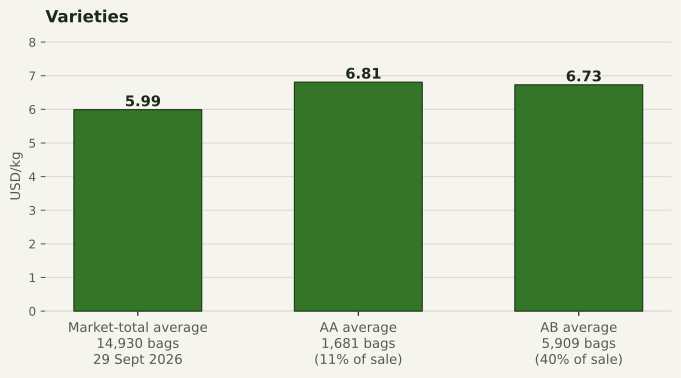
These figures come from the Nairobi Coffee Exchange, not from any exporter's prices or offers, and they aren't broken out by variety. At sale 42, AA and AB averaged only a few cents apart, while AB lots ranged from 3.32 to 7.20 dollars per kg. Variety, block age, cup and factory are all hidden inside that range. Don't read a variety premium into these numbers. The data doesn't contain one.
In practice, you have to ask for variety information separately, and ask before samples ship. Domestic demand, covered in the Specialty Coffee Association's piece on Kenya's local consumption, is not a source on varieties and is not used as one here.
Questions to put to the exporter
Use these as a due-diligence checklist for a lot you're considering. They come from the gaps above. They don't rest on any claim that a standard answer exists.
- Which varieties does the factory's catchment grow, and is the lot declared as one variety or as a blend of several?
- Has any of the supplying land been top-worked or grafted, and when? Field history matters more than the original planting record.
- For Ruiru 11 or Batian material, where did the planting stock come from, and was it vegetatively propagated from pre-selected mother trees?
- Does the claimed variety fit the altitude of the factory against the national variety list's bands?
- Is there genetic purity testing behind the declaration, or is it the producer's word?
- What is the age profile of the blocks, and what are the cupping records for this factory across crop years?
- Did the lot come through the auction or a direct sale, and what does the cupping record say, not the label?
If the answer is unknown, an honest exporter will say so. At Balbans Group and Investments Ltd (BGI), a licensed exporter in Nairobi buying directly in Nyeri, Kirinyaga, Embu, Kiambu and Trans-Nzoia, the position is to name the route a lot came through and to state traceability to the factory. When variety is uncertain, the right answer is to say that it's uncertain. Our buying page explains how to start a conversation about a specific lot.