Kenyan coffee
Grown on red volcanic soil between 1,300 and 1,900 metres, picked by hand over several passes, fermented and fully washed. Kenya produces one of the most recognisable cups in the world: a hard, bright acidity with blackcurrant and dark berry, floral aromatics, and a body that carries them.
What the grades actually mean, which counties grow what, when the crop lands, and how to buy it green and direct from Kenya.
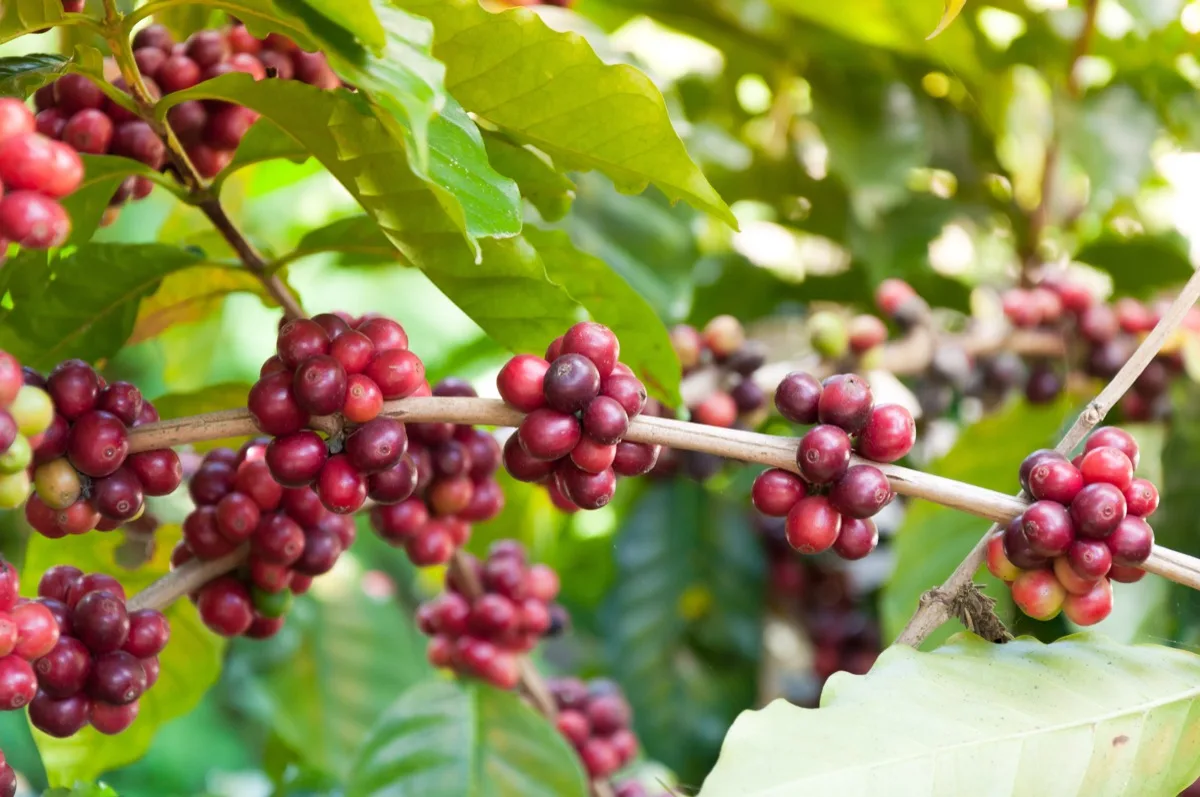
Why Kenyan coffee tastes the way it does
Four things account for most of it, and they compound. The soil on the slopes of Mount Kenya and the Aberdares is deep red volcanic laterite, high in phosphoric acid. The altitude slows the cherry's development, which concentrates sugars and hardens the bean.
The varieties matter as much. SL28 and SL34 were selected in Kenya in the 1930s at Scott Agricultural Laboratories and remain the backbone of the crop, joined by the disease-resistant Ruiru 11 and Batian. SL28 is where the blackcurrant note comes from.
And the processing is unusually thorough: a double fermentation with a soak between, then drying on raised beds. It is laborious, which is why the cup is so clean and why Kenya has never competed on price.
- Species
- Arabica, fully washed
- Varieties
- SL28 · SL34 · Ruiru 11 · Batian
- Altitude
- 1,300–1,900 m
- Soil
- Red volcanic laterite
- Process
- Double fermentation, washed, soaked, bed-dried
- In the cup
- Blackcurrant, dark berry, floral, firm acidity, full body
AA does not mean best. It means biggest.
This is the most common misunderstanding about Kenyan coffee, and it costs buyers money in both directions. Kenyan grading sorts by bean size, shape and density. It says nothing about how the coffee tastes; that is what the cupping score is for, and the two are quoted separately. A good AB routinely cups above a mediocre AA and sells for less.
| Grade | Screen | What it is |
|---|---|---|
| E | 18+ | Elephant bean. Large, often malformed pairs separated during milling. Small volumes. |
| AA | 17–18 | The largest standard grade, roughly 7.2 mm and above. What Kenya is sold on internationally. |
| AB | 15–16 | A and B combined. The largest grade by volume in most harvests, and often the better value. |
| PB | — | Peaberry. One rounded bean where two would normally form. Roasts differently, so sorted apart. |
| C | <15 | Smaller than AB. Clean coffee at a lower price. |
| TT · T | — | Lighter beans off the density table, and the smallest fraction including breakages. |
| MH · ML | — | Mbuni. Cherry dried whole rather than washed. Commercial and soluble. |
Where it grows
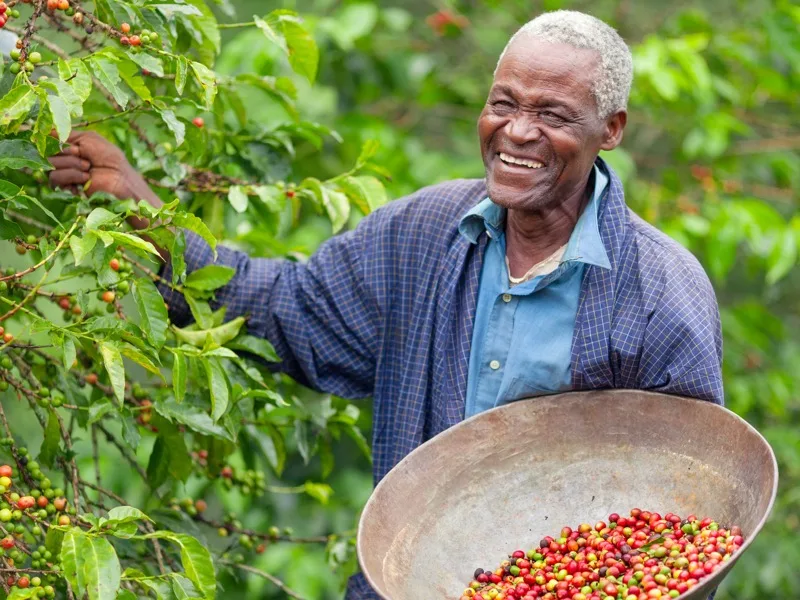
Kenyan coffee is overwhelmingly a smallholder crop, most of it delivered as cherry to cooperative wet mills, known in Kenya as factories, which pulp, ferment and dry it. A single AA lot is usually the pooled output of hundreds of farms around one factory, which is why traceability is stated to the factory rather than to a single farm.
The best-known counties sit on the slopes of Mount Kenya and the Aberdares: Nyeri, Kirinyaga, Embu and Kiambu. Further west, on the Mount Elgon side, Trans-Nzoia produces a rounder, softer cup that reads closer to Ugandan Bugisu than to Nyeri.
When the crop lands
Kenya has two harvests. The main crop carries the volume and the density; the fly crop is lighter and arrives when the northern hemisphere is short of fresh coffee, which is sometimes exactly why a buyer wants it.
Most Kenyan coffee is sold through the weekly auction at the Nairobi Coffee Exchange, with a second window for direct sales. Both routes are legitimate; what matters to a buyer is knowing which one a lot came through, and being told.
- Main crop
- Picked October to December, into January in some areas. Contractable from November.
- Fly crop
- Picked roughly April to June. Smaller volumes, lighter body.
- Sold via
- Nairobi Coffee Exchange weekly auction, or direct settlement
- Shipped
- 60 kg bags, 20 ft containers, FOB Mombasa
- Transit
- Roughly four to six weeks to Northern Europe
Who you deal with
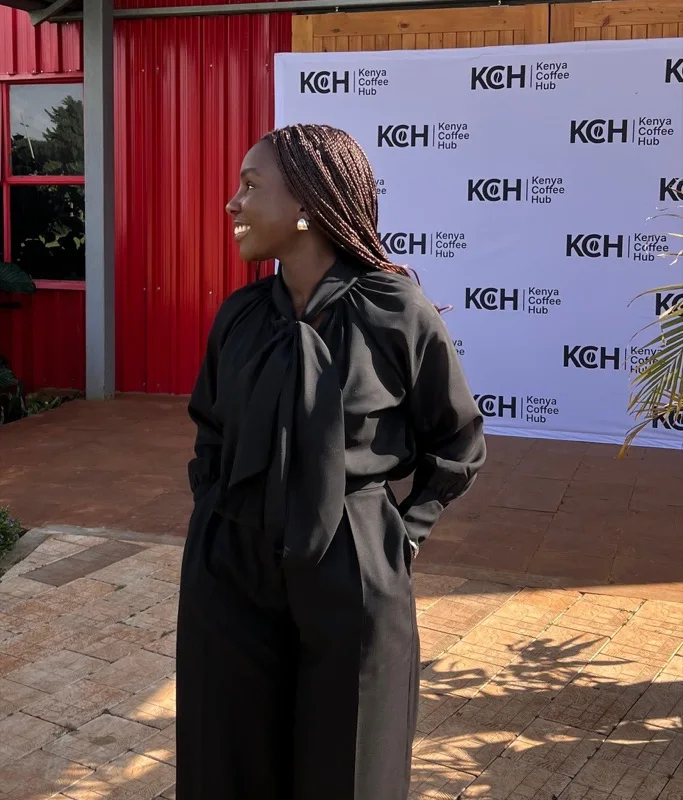
I came to coffee through law. I read for an LLB at the University of Nottingham, then spent four years in international procurement and trade, sourcing from Asia and Europe against awarded tenders.
In 2024 I co-founded The Kenya Coffee Hub, which convenes Kenya's producers, traders, buyers and institutions on the road to KCHIC 2027, an origin-based coffee trade convention hosted in Nairobi. Our launch was backed by Africa Global Logistics, CIC Insurance Group and UNIDO.
That is the background you are buying from: contracts read properly, export paperwork in order, and a direct line to the counties and cooperatives behind every lot. I am Kenyan and Swiss, and I work in English, Swahili and French, so whether you buy from Nairobi, Antwerp or Abidjan, you deal with me directly.
Kenya is hosting a global coffee convention
KCHIC 2027 brings buyers to origin rather than sending Kenyan coffee to be discussed somewhere else. KTN News covered the announcement in May 2026.
“Kenya set to host global coffee convention to boost local trade influence” (KTN News Kenya, 29 May 2026). Rights remain with KTN News Kenya.
Get in touch
Tell us which coffee you are interested in and we will come back to you with what is available, what it costs and how soon it can ship. A grade and a rough volume is enough to start.
You deal directly with Salome Bisau, in English, Swahili or French. salome@balbans.com · +254 706 588 575