Kenyan Arabica
Washed Arabica is, near enough, the whole Kenyan crop: picked over several passes as the cherry ripens, double-fermented with a soak between, and dried on raised beds. A buyer specifies three things against it: the grade, the region and the crop it was picked in. This page sets out how each of the three works.
What we can offer on any given week depends on the harvest and on what has already been contracted, so the live offer list comes by email rather than sitting on this page.
What the grade letters mean
Kenyan grading sorts by bean size, shape and density, not by cup quality. A high grade means a large, dense bean and nothing more; how the coffee tastes is the cupping score's business, and that is a separate number on the offer. Buyers new to Kenya sometimes read AA as a mark of quality. It is a sieve size.
| Grade | Screen | What it is | Typically used for |
|---|---|---|---|
| E | 18+ | Elephant bean. Large, often malformed pairs that separate during milling. Small volumes. | Specialty curiosity lots |
| AA | 17–18 | The largest standard grade, roughly 7.2 mm and above. The grade Kenya is sold on internationally. | Single origin, specialty roasting |
| AB | 15–16 | A and B combined. The largest grade by volume in most Kenyan harvests, and frequently the better value in the cup. | Single origin, premium blends |
| PB | — | Peaberry. A single rounded bean where two would normally form. Sorted separately because it roasts differently. | Specialty, espresso |
| C | <15 | Smaller than AB. Clean coffee, lower price. | Blends |
| TT | — | Lighter, less dense beans separated from AA and AB on the density table. | Blends, commercial |
| T | — | The smallest fraction, including broken beans and chips. | Commercial, soluble |
| MH / ML | — | Mbuni. Cherry dried whole rather than washed, usually from strip-picking or fallen cherry. | Commercial, soluble |
Screen size is measured in 1/64 inch. Screen 18 is 7.2 mm, screen 15 is 6.0 mm. The grades above are the standard Kenyan mill outturn; not every mill separates E or MH/ML on every lot.
The varieties behind the cup
Most of what is planted in Kenya traces back to Scott Agricultural Laboratories, which selected coffee for the colony in the 1930s and gave its initials to the two varieties the country is still known for.
SL28 was selected for drought tolerance and turned out to carry the flavour that made Kenya famous: the blackcurrant note is largely an SL28 trait. It yields modestly and is susceptible to leaf rust and coffee berry disease, which is why farmers keep replanting around it rather than replacing it. SL34 is its higher-yielding sibling, better suited to heavier rainfall, with a slightly softer cup.
The newer plantings answer the disease problem. Ruiru 11, released in 1985, is a compact hybrid resistant to berry disease and rust; it cups below the SLs but survives seasons that would wipe them out. Batian, released in 2010, brought the resistance closer to SL quality and is what most new smallholder planting uses. K7, an older French Mission line, persists at lower altitudes where rust pressure is highest.
- SL28
- 1930s selection. The blackcurrant cup. Drought-tolerant, disease-prone, modest yield.
- SL34
- 1930s selection. Higher yield, handles heavy rain, slightly softer profile.
- Ruiru 11
- 1985 hybrid. Resistant to CBD and rust. Compact, plantable at density.
- Batian
- 2010 release. Disease-resistant with a cup much closer to the SLs.
- K7
- Older French Mission line for lower, rust-prone altitudes.
What “fully washed” actually involves
Kenyan processing is the most labour-intensive standard method in coffee, and the clean, articulate cup is the direct result. Cherry is delivered to the factory on the day it is picked and sorted by hand before anything else happens; unripe and overripe cherry is rejected at the weighbridge, which is where quality is really decided.
The accepted cherry is pulped the same evening, then fermented overnight to break down the mucilage. This is where Kenya departs from most origins: after the first fermentation and washing, the parchment goes into a second fermentation, or a long clean-water soak, sometimes both. Nobody fully agrees on the chemistry, but the double treatment is consistently associated with the brightness and clarity Kenyan coffee is bought for.
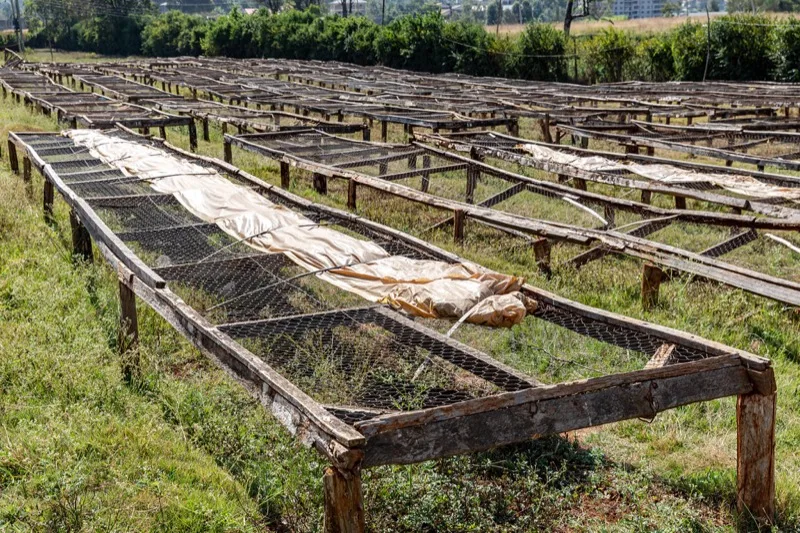
After washing, the parchment is graded by density in water channels, where the densest beans travel furthest, and then dried slowly on raised beds for one to two weeks, turned by hand, covered against midday sun and rain. Only then does it go for milling, where the grades on this page are separated.
Five growing areas
These are the areas BGI buys from directly. They are not the only places Kenya grows coffee; the full county-by-county picture is on where Kenyan coffee grows. They are the ones where we have standing relationships with cooperative societies and factories.
| Area | Altitude | Character in the cup | Notes |
|---|---|---|---|
| Nyeri | 1,600–1,900 m | Dense, structured, blackcurrant and dark berry, firm acidity | Red volcanic soil on the Aberdares and Mount Kenya slopes. The reference point for Kenyan coffee. |
| Kirinyaga | 1,300–1,900 m | Bright, citric, floral; often the cleanest acidity of the five | Dense concentration of cooperative wet mills. |
| Embu | 1,300–1,800 m | Rounder, softer fruit, moderate acidity | South-eastern Mount Kenya. Smaller volumes than Nyeri or Kirinyaga. |
| Kiambu | 1,500–1,800 m | Balanced, chocolate-leaning, gentler acidity | Estate as well as smallholder. Close to Nairobi, under pressure from urban expansion. |
| Trans-Nzoia | 1,500–1,900 m | Fuller body, softer acidity, sweet finish | Western Kenya, Mount Elgon side. A different profile from the Mount Kenya areas. |
Altitude bands describe the coffee-growing land in each area, not a guaranteed figure for a given lot. The altitude of the specific lot is one of the four fields recorded when we buy.
Two crops a year
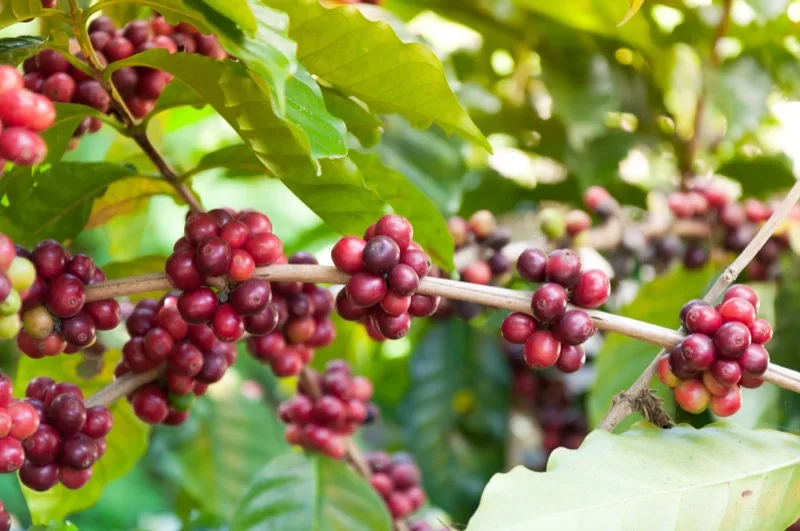
Kenya picks twice a year, and the two crops are not interchangeable. The main crop carries the volume and the density. The fly crop is smaller and lighter in body, but it is picked months out of step with the main harvest, and for a roaster timing arrivals that gap is the point.
Shipping from Mombasa to Northern Europe is typically four to six weeks on the water, so a contract signed at the peak of the main crop generally lands in the first quarter.
- Main crop
- Picking October to December, into January in some areas. Milling and grading follow; most main-crop lots are ready to contract from November.
- Fly crop
- Picking roughly April to June. Smaller volumes, lighter body.
- Auction
- The Nairobi Coffee Exchange runs a weekly auction through the season, alongside a window for direct sales. We will tell you which route a lot came through.
- Shipment
- FOB Mombasa. Green coffee ships in 60 kg bags, in 20 ft containers.
The auction, and what a lot costs
Most Kenyan coffee is sold through the weekly auction at the Nairobi Coffee Exchange. Milled lots are catalogued under an outturn number, samples go out to the licensed trade beforehand, and the room bids on what it has already cupped. The outturn number stays with the coffee, which is why a Kenyan lot can be traced backwards from an invoice to a specific mill week without any special paperwork.
Alongside the auction there is a direct-sale window, in which an exporter and a buyer agree terms bilaterally. Neither route is better in itself; the auction gives a transparent market price, direct sale gives programme continuity. A serious offer tells you which route a lot came through, unprompted.
What drives the price
Arabica trades against the New York “C” futures contract, and Kenyan coffee sells at a differential above it, lot by lot. The differential moves with the grade, the cup, the outturn and the season, and for the best lots it is a multiple of the terminal price rather than a rounding error on it.
That is why nobody quotes a flat, standing price for Kenyan AA, and why a fixed number on a website would be stale before it was read. A firm quote names the lot, the differential and a validity window. Everything else is an indication.
The number that says how it tastes
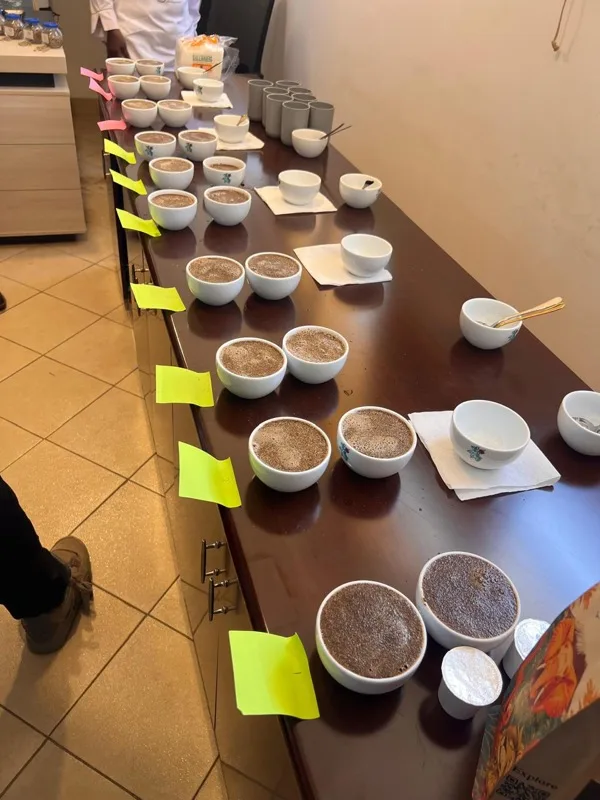
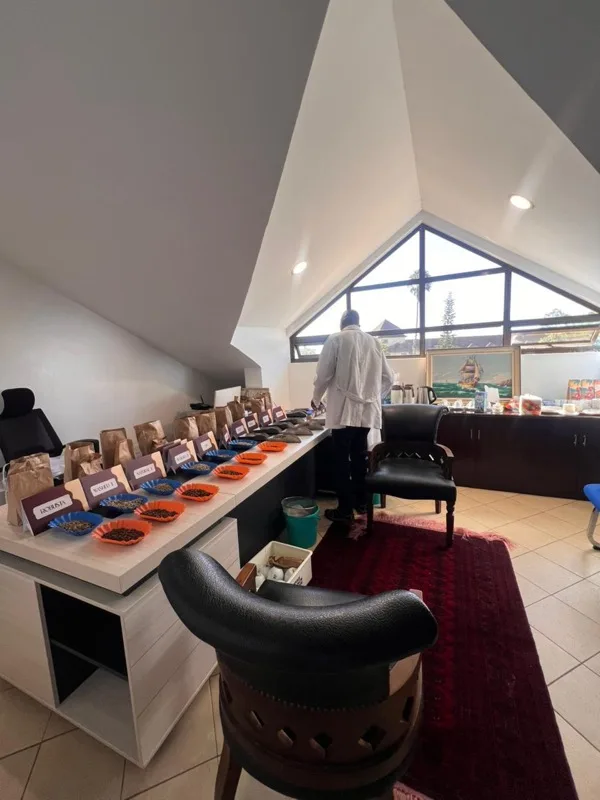
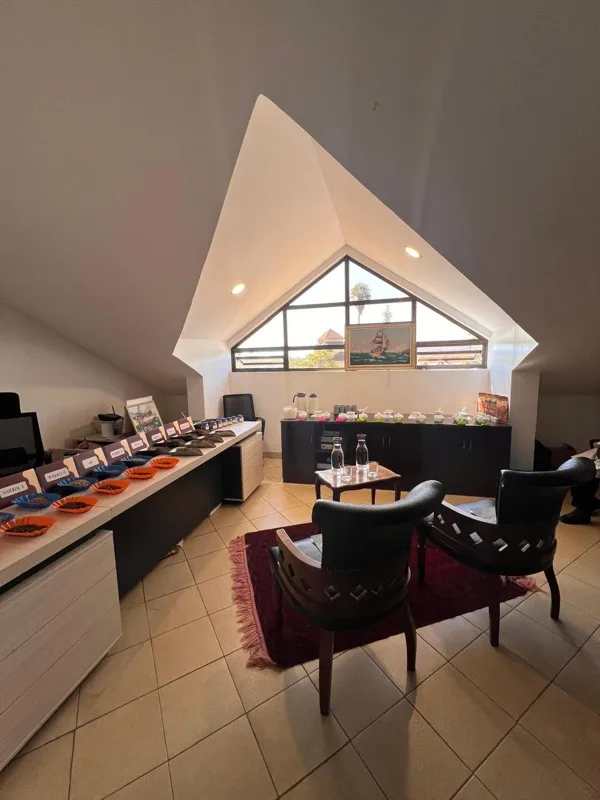
The grade tells you the bean’s size; the cupping score tells you whether the coffee is any good. Licensed liquorers score each lot on the 100-point scale used across the specialty trade, weighing fragrance, acidity, body, sweetness, uniformity and cleanliness of cup. Anything from 80 counts as specialty; well-prepared Kenyan AA and AB from a good factory routinely lands in the mid-to-high 80s, which is why Kenya is priced the way it is.
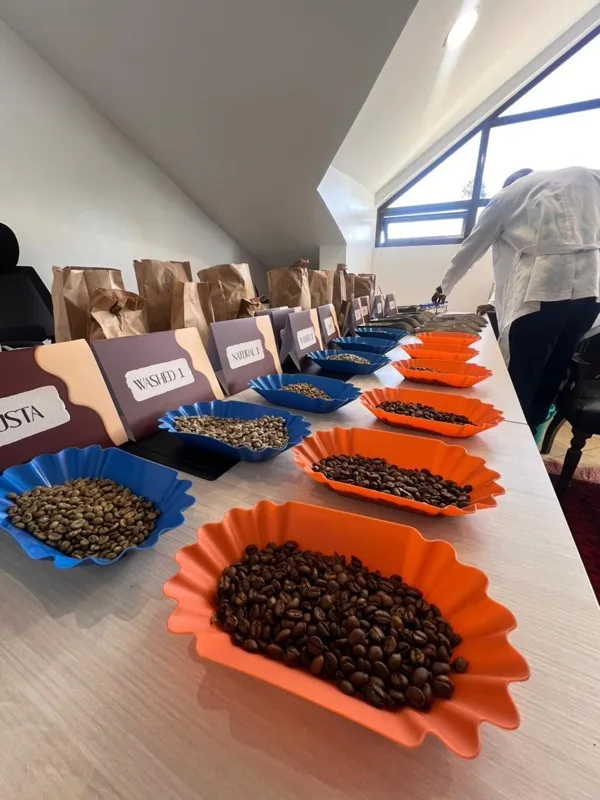
For a buyer the practical rule is simple: ask for grade, outturn and score together. A big bean with a modest score is expensive decoration. A high-scoring AB is often the smartest purchase on the list, and the sample tells you more than either number, which is why we would rather send one than argue in adjectives.
Get in touch
Tell us which coffee you are interested in and we will come back to you with what is available, what it costs and how soon it can ship. A grade and a rough volume is enough to start.
You deal directly with Salome Bisau, in English, Swahili or French. salome@balbans.com · +254 706 588 575