If you are an importer or roaster buying Kenyan green coffee, the Nairobi Coffee Exchange auction is the main way it reaches you. The auction runs on a weekly sale, a catalogue, a sample room and a results sheet. The numbers below come from the exchange's own results. They are not an exporter's offer, and they are not an FOB price.
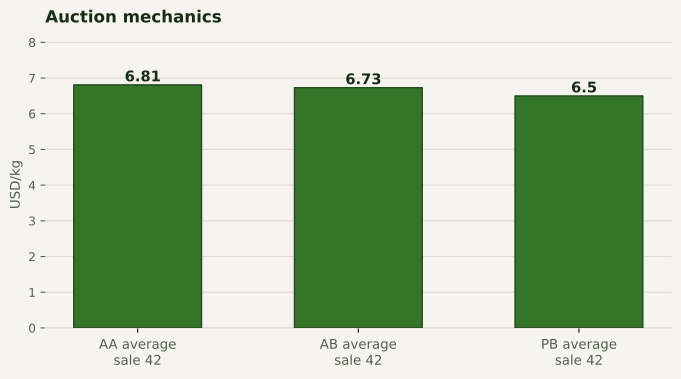
Average price per grade at the Nairobi Coffee Exchange, sale 42 on 29 September 2026, in US dollars per kilogram. Auction results, not an offer price.
The calendar is looser than the Tuesday habit
The calendar is the first thing to check, because it corrects the usual shorthand. On the Nairobi Coffee Exchange homepage, upcoming auctions are listed for Wakulima House, 1st and 2nd Floor, Haile Selassie Avenue, Nairobi. Week 41 falls on a Tuesday at 9:00 am EAT. Week 42 falls on a Wednesday at 8:00 am EAT. So calling it "the Tuesday sale" is a habit, not a rule.
Perfect Daily Grind's explainer on the exchange says the NCE holds auctions every Tuesday unless there is insufficient volume. Put that together with the calendar and the working picture is a weekly sale with a Tuesday default, a calendar that can move a day, and a possibility that a week simply does not run. Our measured data says the same from another angle: the auction pauses between seasons, so a gap in results is not a missing page.
For a buyer, the consequence is practical, not academic. Samples have to be cupped before the sale, and the cupping table has to be booked around the sale day, not around a weekday you assumed. If your quality team plans a Monday cupping for a Tuesday sale and the exchange has shifted to Wednesday morning, you have a day to spare. If it has shifted earlier, you do not. Check the exchange's calendar each week and treat the weekday as data rather than as a rule.
That same page is where the exchange publishes what it calls final auction results by sale number. You will return to that document most often, and a later section reads one.
Who runs the exchange, and which source to believe
The exchange's About page describes the NCE as the central marketplace for the marketing, trading, pricing and settlement of Kenya's coffee. Its history page dates the first auction to September 1935. The Daily Coffee News account of the exchange gives the same decade: the Coffee Board of Kenya was established in 1931 and the first auction followed in 1935.
Be careful with older descriptions of who manages the place. A 2002 USDA GAIN report, the Coffee Annual for Nairobi, says the marketing policy retained a central auction managed by an association to be called the Kenya Coffee Producers and Traders Association. That is a 2002 statement of policy. It is earlier practice, and it is not how the exchange describes itself now. The 2021 Perfect Daily Grind piece says the NCE is managed by its Exchange Management Committee and regulated by the Agriculture, Food and Fisheries Authority, and that it is the sole auctioneer of Kenyan coffee. That is the description to use.
The Daily Coffee News piece needs the same discipline. It is from 2018 and it describes a sequence of changes: before 2002 the Coffee Board of Kenya was the sole marketing agent for smallholder cooperative coffee, in 2002 the board was restricted to a regulatory role and six independent agents were approved, and since 2006 room has been made for 25 more. Read that as history and as a catalogue of recurring complaints. Do not read it as a live rulebook.
For a buyer, the rule is straightforward. If an older article conflicts with the exchange's own pages, trust the exchange. The year in the article's address tells you how much weight that article deserves.
From dry mill to catalogue: the outturn number
Perfect Daily Grind lays out what happens at the dry mill. Before milling, grading and storage, the coffee gets a unique tracking number: the outturn number. The green coffee then goes to a marketing agent, the party that sells coffee for the grower. That agent builds a catalogue of all its lots and sends it to traders ahead of the next weekly sale.
Keep the outturn number close. It is the buyer's traceability key. It is not the auction lot number, which identifies a lot within a single sale, and it is not the producer's name shown on the display. The outturn number travels with the coffee. If a lot fails to sell and comes back in a later sale, it keeps the same outturn number under a new lot number. That is how you spot a coffee you have already seen.
Sale 28's transaction listing gives a real example. One AA lot carries the mark and outturn certificate 18SM0120/KATHIMA/XBD05F01 EUDR. The string includes a mill mark, with Kathima in it, and ends in EUDR. That suggests the lot was marked for the European deforestation rules. The listing does not explain the code. Treat that reading as a reasonable inference, and ask the seller what the suffix means before you depend on it for compliance.
In Kenya, traceability reaches the washing station, which the trade calls a factory, not one farm. A lot is the pooled output of many smallholders who deliver cherry to one cooperative wet mill. The outturn number takes you to the dry mill's records and the factory behind them. It will not take you to a named grower. If a seller promises that, ask how.
The sample room and the cupping week
According to the Perfect Daily Grind explainer, the Nairobi Trade Sample Room holds around 9kg of every lot due to be auctioned the following Tuesday. From that stock, the exchange splits parcels of 250g and sends them out as pre-auction samples. Each lot is shown with its outturn number, lot number, grade, number of bags, total weight in kilograms, and producer's name.
Notice the word 'around'. The source says approximately 9kg, so do not count on an exact figure. Do the math only as far as the source goes: a parcel is 250g, and a limited stock of them represents a lot. For a buyer, that has two effects. The trader who receives the parcel is the one who cups it. A roaster buying through a dealer sees the coffee only as far as that dealer's cupping and sharing allow. And a small sample is a small sample. A lot of many bags is judged on a few hundred grams, so for a large decision a buyer wants to roast the parcel consistently and cup it more than once.
Licensed liquorers score quality on the 100-point scale. A score of 80 and above counts as specialty. Grade is separate. Kenyan grades such as AA and AB sort by bean size, shape, and density, not cup quality. A good AB can cup above a mediocre AA. The grades explainer on this site covers the screen sizes, so here it is enough to say that the catalogue line gives you the grade and the cup gives you the coffee.
This picks up where the calendar in the first section left off. Once the sample room is filled for the next sale, your cupping window runs from the day samples go out to the day of the sale. Move the sale by a day, and that window shifts with it.
Reserve prices and the noted bid
Every lot carries a reserve price. Perfect Daily Grind says that reserve is linked to the C price (the New York arabica futures benchmark) and to the coffee's grade and quality. The seller or the marketing agent sets it. In the room, the top bid takes the lot. That's the simple version, and mostly it holds.
Then there's the noted bid, which complicates things. Perfect Daily Grind gives this example: a lot has a reserve of Sh220. Bids start at Sh100 and only reach Sh160. The auctioneer may take that price as a noted bid, and the buyer negotiates with the auctioneer afterward. So the price comes in two stages. Stage one is public, a bid in the room. Stage two is private, a negotiation after the hammer. The source doesn't say how often noted bids happen or where those talks end up. No figure exists for either, so anyone who quotes one is guessing.
So what does that mean for the price you see later? The results sheet shows a price, but from that number alone you can't tell if it was a clean bid above the reserve or a noted bid settled after the sale. For a trader comparing a lot to a reserve, that difference matters. For an importer it matters less. Still, it's another reason to treat one lot's price as a single data point, not the market.
The reserve is also where futures come in. Kenyan coffee trades at a differential above the C price, lot by lot. For the best lots, that differential can be a multiple of the terminal price. When a reserve is tied to the C price and adds a grade and quality premium, it's the seller's opening statement of that differential.
Dealers, agents and who actually bids
Two groups need separating. Marketing agents bring coffee to the sale for growers or cooperatives. Licensed dealers, the traders, bid on it. The Daily Coffee News article says that by one report in 2011, 76 traders were licensed in Kenya, but only around five were really active. That led to predictable complaints of collusion on prices. That's a 2011 figure reported in a 2018 article. It is not a count of today's active bidders. Read it that way.
The same article says independent marketing agents often work for millers or, worse, for bidders who may be acting for importers, even though rules prohibit that. It also says international buyers and vertically integrated estates skim off the top 5 to 15 percent of the highest-quality coffees before those coffees reach the NCE. Treat both as the author's account from one publication, not as measured fact. Still, they point to the right question for a buyer: how much of the best coffee is visible on the floor at all?
Sale 28's listing gives a narrow, direct view of who's buying. Buyers named on lots include Ibero Kenya Ltd, Louis Dreyfus Company, Jabali The Coffee Company, Taylor Winch (Coffee) Limited, Sasini (K) Limited and Global Mark Foods Ltd. Six lots doesn't equal market share, and the listing doesn't rank buyers. But it does show that both familiar international trade names and local houses turned up in the same sale.
If you are an importer buying by the container, the practical takeaway is this: you seldom bid yourself. Either you buy through a licensed dealer or an exporter who bids for you, or you buy outside the auction. The questions go to whoever you have the contract with. Which lots did you cup? What route did the coffee take? And what price are you quoting me, exactly?
Payment, warrants and the long wait behind them
Once trading closes, the NCE draws up a document that records which coffees sold, who bought them, which parties they came from, and the price paid. Marketing agents and buyers get it for transparency. Buyers have to pay promptly, generally within 7 or 14 days. When payment is made, a warehouseman issues a coffee warrant. That warrant gives the buyer formal ownership of the lot.
The exchange's own pages explain how the money moves. NCE says the Direct Settlement System (DSS) reduces risk in the financial environment and allows secure, timely payments between buyers and sellers. That is financial infrastructure, not price discovery. For a buyer, it is the reassuring end of the chain. You pay into a defined system, and you get a warrant back.
The other end looks different. Perfect Daily Grind reports that the money goes to the marketing agent, not to the farmer, and the agent takes out fees before paying farmers or cooperatives. Salome Muringi, a washing station manager quoted in the piece, says payment sometimes takes almost a year, while marketing agents are often paid within seven days. She asks for advances at least to cover farm labour. Keep the two timelines separate. The 7 or 14 days is what the buyer owes. It is not what the farmer receives.
Why should an importer care? A supply chain with a slow, thin end is a supply chain with fragile loyalty. The same piece quotes Grace Mganga, a former cooperative chair, who says pricing at the NCE has no transparency. It also quotes Japheth Wambugu, a coffee expert in Nyeri County, who argues for a more transparent auction with stricter government oversight. Those are opinions from named people, not findings. They still explain why some cooperatives want a direct route.
What happens to coffee that does not sell
Not every lot finds a bidder. Perfect Daily Grind says unsold coffee stays in the Trade Sample Room as sweepings and is collected by the marketing agent that offered it. Usually the dry mill draws more samples before the coffee is offered again. That repeats until a buyer is found.
There is a cost buried in that loop. An anonymous source quoted in the same piece says all this sample drawing reduces the volume the producer keeps, while benefiting the auctioneer. One unnamed voice is weak evidence, and the piece gives no volumes, so no figure can be attached. But the mechanism is clear. Every offering needs fresh sample coffee, and sample coffee comes out of the lot.
For a buyer, an unsold lot is not necessarily a bad coffee. A reserve set above what bidders will pay leaves a lot unsold, whatever its cup score. The outturn number is again the key. If a coffee reappears in a later catalogue under the same outturn number with a new lot number, ask the agent or your dealer why it failed to sell and what has changed. The honest answers are a lower reserve, a different grade split, or a changed market.
Then you have the Second Window. A 2006 law lets producers and buyers deal directly through a private export company, skipping the auction platform. According to the Perfect Daily Grind piece, direct trade is only a fraction of Kenyan coffee sales. The NCE handles 85% to 95% of Kenyan coffee. If a seller offers a lot through that window, it is a bilateral sale. A good exporter will tell you which route the lot took.
Reading a transaction listing: sale 28
The exchange's Sale 28 transaction listing lists lot number, marks and outturn certificate, grade, full bags, weight in kilograms, price per 50Kg, gross value, buyer and clock status. That is about as close as you get to a receipt for the whole sale. In the figures we have, the listing prints no currency symbol. Read the numbers as they appear, and take the unit from the column heading.
The columns reconcile, and you can check them. Lot 5901, grade T, has 4 full bags and 261 kilos at a price of 257 per 50Kg. 261 divided by 50 is 5.22, and 5.22 times 257 gives 1,341.54, which is the gross value shown. Lot 7323, grade AB, has 82 full bags and 4,985 kilos at 367, and 4,985 divided by 50 times 367 gives 36,589.90, again as shown. So the price column is per 50 kilos, and gross value follows from actual weight, not from a bag count.
Lots can spread wide. In sale 28, AB lot 7323 is listed at 367 per 50Kg. AA lot 5929 is at 320, C lot 5911 at 319, T lot 5901 at 257, UG1 lot 5941 at 195 and UG2 lot 7344 at 76. The point here is an AB lot sitting above an AA lot. Grade sorts by size, while price follows the cup and the market. These are single lots from one sale. They show the range, and they are not an average.
Lot sizes differ too. The AA lot has 3 bags, the AB lot has 82 and the UG1 lot has 50. A container-scale buyer will see that few lots are large on their own. That is why consolidation across lots matters. Every lot here shows a status of Confirmed. An unconfirmed result would appear in the clock status column.
What the latest sale says, and how to use it
At sale 42 on 29 September 2026, the exchange's market total covered 14,930 bags, or 927.2 tonnes. That is an average of 5.99 US dollars per kilogram, or 300 dollars per 50 kg. Total value was 5.56 million dollars. The auction settles in dollars. For shilling conversions, use the sale-date rate of 129.67 shillings per dollar.
By grade, AA averaged 6.81 dollars per kg across 1,681 bags, 11 percent of the sale. AB averaged 6.73 over 5,909 bags, 40 percent. PB averaged 6.50 over 720 bags. C averaged 6.12 over 2,821 bags, 19 percent. At the low end, T averaged 3.96 and ML 2.24. AA's lead over AB is 0.08 dollars per kg (6.81 minus 6.73). That is thin for a grade that is bigger and rarer. Look at the ranges. AB ran from 3.32 to 7.20, and PB from 3.84 to 9.60. A grade average hides more than it shows. The grades piece already looked at that, and the cup decides within a grade.
The last 12 auctions ran from 14 July to 29 September 2026. Over that stretch, the market-total average went from 5.88 dollars per kg (22 September) to 7.63 (14 July). The first sale in the run averaged 7.63, and the latest averaged 5.99. The AA average over the same 12 sales ranged from 6.81 to 8.32, with a median of 7.69. That makes the latest AA the lowest of the run. Two readings are possible: a seasonal change in what is being offered, or a softer market. The data does not choose between them.
Treat these as background for a chat, not a quote. They are market totals. If you need a firm quote on a container, ask for the route and the lot in writing, and to see where the coffee grows, the origin map tells you what the lot's mark implies.