Look at a Kenyan coffee spec sheet and a letter hits you first: AA, AB, PB, C. A buyer new to Kenya reads it as a quality tier, something like Reserve or Grand Cru on a wine label. It is not. Those grades are sieve sizes. The screen a bean falls through decides the letter. Once you understand that, you read a sample differently and you write the contract differently.
A grade is a hole in a metal sheet
Coffee bean grading by screen size did not start in Kenya. The ICO's grading and quality guidance lays out the same mechanism used in other origins. Unroasted beans move over perforated containers, and the largest hole a bean cannot pass through gives its classification. Kenya's AA is Grade 18: the bean goes through an 18/64 inch (7.2 mm) perforation but not a 16/64 inch (6.0 mm) one. That is the whole definition. No cup criterion enters it.
That pattern is not unique to Kenya. Colombia's Supremo grade uses the same Grade 18 sieve, while Excelso sits one screen down at Grade 16, according to the ICO document. The ICO also notes a convention: even numbers (20, 18, 16) were traditionally reserved for Arabica sieves, odd numbers (17, 15, 13) for Robusta. That convention places Kenya's whole letter system on the Arabica side of a much older classification most buyers never see spelled out. Supremo and Excelso, the ICO adds, can come off the same tree, split only by which screen caught them. Kenyan AA and AB work the same way: pooled cherry from the same cooperative wet mill, called a factory in Kenya, separated afterward by size.
What the Kenyan letters actually cover
Kenya runs its own grade names on top of the screen convention. Each one marks a physical cut, not a verdict. E is screen 18 and above, the largest fraction. Some call it elephant bean, and not every mill separates it out on every lot. AA sits at screen 17 to 18, roughly 7.2 mm and above, and it is the grade buyers ask for first. AB, screen 15 to 16, is usually the largest grade by volume from any given factory. It is the bulk of the crop, not a discount tier. PB is peaberry, a rounder single seed rather than the usual flat-sided pair, sorted by shape rather than size alone. C falls below screen 15. TT and T come off the density table rather than the size screens: TT catches lighter beans sorted by density, T is the smallest fraction, including broken beans. MH and ML are mbuni, cherry dried whole rather than pulped, a different processing path entirely rather than a size cut.
None of that list tells you anything about acidity, body or aroma. It tells you what a bean's outline is.
Why size correlates with cup quality, loosely
The link between size and flavour is real but weak. The ICO says so directly: AA is used as a quality grade because of a general correlation, with many exceptions, between bean size and flavour. Altitude does more of the actual work. Coffee grown higher tends to be denser and larger. Separate grading conventions, hard bean and strictly hard bean, exist precisely to flag that altitude effect where sieve size alone would miss it. Kenya does not publish an altitude-based letter of that kind. Its own grades stop at size, shape and density.
The instrument that actually measures cup quality is a different one: the 100-point Q-grading scale, where anything below 80 is commodity rather than specialty. It applies to Arabica only, runs on roughly 5,000 trained graders worldwide, and was built by the Specialty Coffee Association with certification managed by the Coffee Quality Institute. It has nothing to do with screen numbers. A well-processed AB lot from a good factory routinely cups above a mediocre AA. Treating AA as shorthand for specialty is the single most common misreading buyers bring to a Kenyan offer sheet. Unlearn it before you set a floor price on the letter alone.
The colonial arithmetic behind why AA leaves the country
The grade hierarchy carries a history that is more than technical. Under the 1923 Devonshire White Paper, Kenyan growers permitted to plant coffee were barred from consuming it themselves. Every lot went to central mills, and the highest grades were reserved for export. That allocation still shows in the numbers: Kenya exports about 95 percent of what it grows, according to reporting summarised by the Specialty Coffee Association on Kenya's domestic consumption trend, with only 5 percent consumed at home, even as domestic demand has grown, up 19 percent between the 2021/22 and 2022/23 seasons by the Agriculture and Food Authority's figures cited in that same piece. The grade names a buyer sees on an outturn sheet were built, from the start, around the assumption that the best of the crop leaves.
Kenya remains only the fifth-largest producer in Africa, at 48,648 metric tons in the 2022/23 season per the same source. That is smaller than its reputation among roasters would suggest. Scarcity, not just quality, is part of why top lots draw the differentials they do.
What the auction actually paid for each grade
Grade names sort beans. They do not set the price by themselves. The auction record shows how the market ranks them at a given sale. At the Nairobi Coffee Exchange's sale 41, held on 22 September 2026, all grades together came to 14,005 bags (865.6 tonnes), averaging 5.88 dollars per kilogram, or 294 dollars per 50 kg bag. By grade: AA averaged 6.87 dollars per kg across 1,804 bags, AB averaged 6.64 across 5,351 bags (38 percent of the sale, the largest single share), PB averaged 6.46 across 633 bags, C averaged 5.90 across 2,648 bags, TT averaged 5.44 across 321 bags, T averaged 3.85 across 694 bags, MH averaged 4.54 across 1,143 bags, and ML averaged 2.32 across 369 bags.
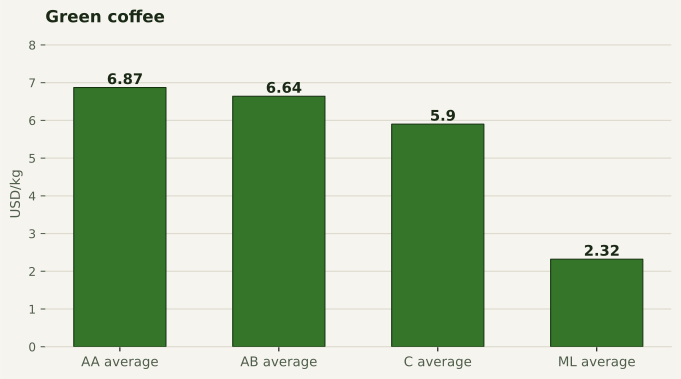
The ordering (AA above AB above PB above C) did show up in this sale, but it is a market result, not a rule written into the grading system. Within AA, lots in sale 41 went from 4.50 to 7.60 dollars per kg. That spread is wider than the gap between the AA and AB averages. A weak AA lot can sell below a strong AB lot in the same sale. Grade puts a lot in a size bracket. The liquorer's cup score and the buyer's own sample assessment decide where inside that bracket it lands.
How much the average itself moves, sale to sale
Grade differentials also shift because the baseline moves. Over the twelve auctions from 12 May to 22 September 2026, the market-total average across all grades ran from 5.16 dollars per kg at the earliest sale to 7.63 at the highest, then settled at 5.88 for sale 41. AA alone ranged from 6.55 to 8.32 over the same run, with a median of 7.81. A buyer comparing an offer against last month's number without checking which sale it came from is measuring against a moving target. The exchange pauses between seasons and restarts each new crop at a different level entirely.
That is also why any exporter who works this market honestly will not quote a standing price for a grade. A firm offer has to name the lot, the differential over the New York C contract, and a validity window. The reason is that the auction setting the reference point for direct sales moves by several dollars per kilogram across a single season. Reading last month's average as this month's floor is a common and costly mistake for a buyer new to the exchange.
Reading a spec sheet without the grade doing your thinking
A practical habit: when a spec sheet lists AA, ask three separate questions rather than one. What is the screen range, has E been split out or folded in, and what cup score did the liquorer record. The first two answer size, the third answers quality. Conflating them is where buyers overpay for a grade letter and underpay for an actual cup. The same discipline applies below AA. TT and T are sorted by density rather than size, which means a T lot is not simply a smaller AB. It includes broken beans and material the density table rejected from the larger grades, and it prices accordingly, at 3.85 dollars per kg average against AA's 6.87 at sale 41, a gap of exactly 3.02 dollars shown in the same sale.
Peaberry deserves a specific note. It is not a size cut at all but a shape cut: a single rounded seed forms inside the cherry instead of the usual flat-sided pair. Some buyers pay a premium for PB on the belief that a single seed concentrates flavour. The sale 41 data shows PB averaging 6.46 dollars per kg, between AB and C, not above AA. Treat any PB premium claim with the same scepticism you would apply to an AA-as-specialty claim: check the cup score, not the shape.
Blending, and where Kenyan grade sits in someone else's cup
Not every bag of Kenyan AA ends up as a single-origin offering. Research cited in the EU study on marketing Kenyan coffee under a geographical indication puts more than 60 percent of Kenyan coffee into blends. The USDA Foreign Agricultural Service's Kenya coffee annual report notes that Kenyan AA Arabica is sometimes blended with Ugandan or Tanzanian Robusta to meet a target profile for the European market. For a buyer sourcing to blend, the grade letter still only tells you the sieve fraction going into the mix. The blend's final character depends on what else is in the cup. Kenya itself grows very little Robusta of its own, so any Robusta component in a blend built around Kenyan Arabica is coming from elsewhere in the region, not from a Kenyan grade at all.
This is one more reason to keep grade and quality in separate columns on your own spec sheet, rather than trusting the letter to carry both jobs.
Varieties sit underneath the grade, not inside it
The grade letter also won't tell you which tree the bean came from. In Kenya that matters more than in most origins, since the varietal mix has shifted hard over the last generation. SL28 and SL34 still form the backbone of the crop. They were selected in the 1930s at Scott Agricultural Laboratories, and they carry the blackcurrant character Kenya is best known for. Disease pressure, though, has pushed replanting toward Batian and Ruiru 11. Batian was released in 2010 from fifth-generation selections at the Coffee Research Institute in Ruiru, with parentage that includes SL28, SL34, Rume Sudan, N39, K7 and the Timor Hybrid. Both were bred for resistance to coffee berry disease and leaf rust. As of 2019, the World Coffee Research profile of Kenya puts the number of families replanted with disease-resistant varieties at roughly 300,000. Two AA lots from the same season can have different varietal mixes and different flavour outcomes even with the same sieve grade. For more on how the grade system maps onto Arabica varieties specifically, see Kenyan Arabica grades and screens.
What a buyer should ask for instead of a grade name alone
A grade letter belongs on a purchase order. It should never be the only line on it. Ask for the outturn number. It stays attached to the lot from cataloguing through sale and lets you trace it back to the factory of origin. Ask for the liquorer's cup score alongside the grade. The two numbers answer different questions, and a good buyer wants both answered before quoting a price. Ask which harvest the lot comes from. Kenya's main crop is picked October through December and into January in some areas, and it differs in body from the smaller fly crop picked roughly April to June. A spec sheet that omits harvest timing is hiding a real variable behind a grade letter that cannot carry it.
This does not replace your own cupping. It just shows you what question the grade letter actually answers, so you can spend your cupping time on what a sieve cannot measure. For background on how a container purchase is structured once you have settled on a grade and a cup profile, see buying Kenyan green coffee. The varietal detail above also draws on Batian.