In Kenya, a coffee lot first gets written down at a cooperative wet mill. Kenyans call it a factory, and the whole supply chain turns on that word. The New Kenya Planters Cooperative Union's 2025 count, quoted in the SCA's feature on Kenya's domestic coffee market, puts the sector at roughly 800,000 smallholder farmers and 550 coffee cooperatives. Smallholders with under 5 acres bring harvested cherry to their society's factory, which pulps and washes it, according to the European Commission's 2013 study on marketing Kenyan coffee as a geographical indication. The farmer carries fruit; the factory makes parchment. The weighing slip at the gate is the first document in the chain.
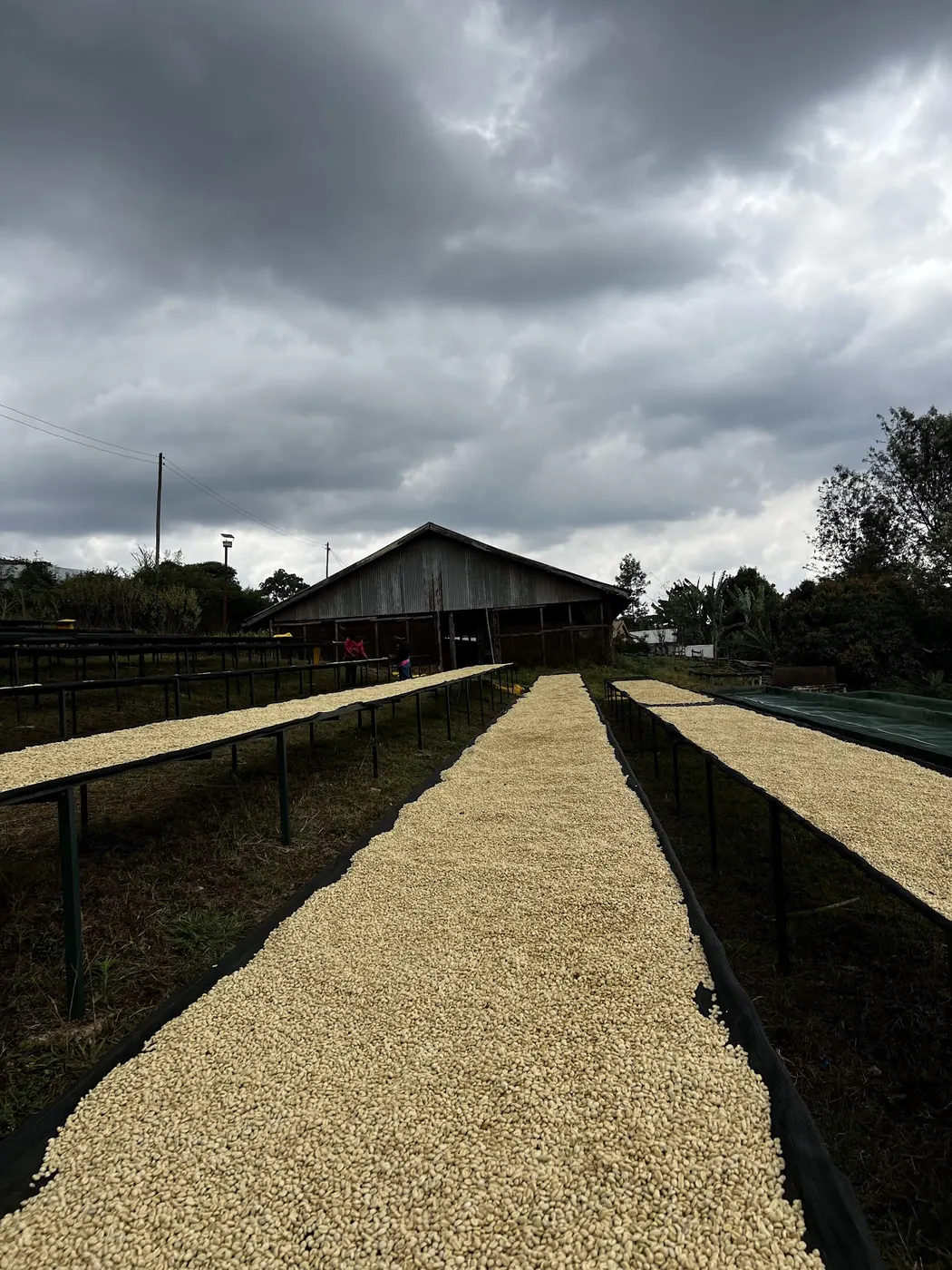
The record starts at a factory gate, not a farm
History explains some of it. The SCA piece recounts the 1923 Devonshire White Paper: it let a select few Kenyans grow a limited number of coffee trees, barred them from producing coffee for consumption, required all coffee to be processed at central mills, and earmarked the highest grades exclusively for export. Central milling was part of the system before most of today's growers were allowed in. Cooperative factories took on that role, and the paperwork followed.
At the factory, workers hand-sort cherry on picking day, pulp it that evening, ferment it overnight, give it a second fermentation or a long soak in clean water, grade it by density in channels, and dry it on raised beds for one to two weeks. Every step applies to the pooled fruit. That fruit comes from whichever members delivered that day. Once the parchment is dry, the individual farm has disappeared into the factory's day lot.
For a buyer, this changes what traceable can honestly mean. A single AA lot usually comes from hundreds of farms around one factory. So the correct origin statement is the factory name, the cooperative society it belongs to, and the county. A supplier who offers a farm name on a cooperative lot is selling either an estate or a story. Which factory, which society, and which delivery dates went into the lot: those three things exist on paper. A farm name usually does not. Ask for the three, and treat anything finer as decoration until a document shows up.
Estates, and the count nobody agrees on
Estates go the other way. An estate picks, pulps, ferments, and dries its own cherry, so its parchment is single-origin in the literal sense. The record can reach back to a block of trees. That is the exception in Kenya, and the sources a buyer is most likely to be shown disagree on how big that exception is.
The SCA, quoting the New Kenya Planters Cooperative Union, gives approximately 4,000 coffee estates as of 2025. FAO's account of its coffee value chain investment roundtable in Kenya gives over 2,520 estates and the same figure of over 800,000 smallholders. Both numbers cannot describe the same thing. One may count registered estates and the other active ones; the sources do not say. This matters because a counterparty quotes the estate count to explain why a lot is scarce or carries a premium. Quote both figures, name both sources, and let the discrepancy stand. Averaging them produces a number nobody published.
The sources do agree on scale and spread. Kenya's Coffee Development and Marketing Strategy from the Ministry of Agriculture records coffee grown in 33 counties and lists the value chain as growers, millers, brokers, traders, and consumers. SCA puts 2022/23 production at 48,648 metric tons, with 95 percent exported and 5 percent consumed at home. Against those totals, the estate sector is small whichever count is right. That is why an estate lot in a Kenyan catalogue reads as a different product from a cooperative lot: same grade letter, different chain of custody, different claim a buyer can defend to a customer.
Parchment leaves the factory and custody changes for the first time
Dry parchment leaves the factory. It goes to a dry mill, where it is hulled, cleaned, sorted by screen and density, and bagged by grade. There the factory's pooled parchment turns into the lots a buyer later sees: AA at screen 17 to 18, AB at screen 15 to 16, PB for peaberry, and the smaller fractions below. Those letters are only a sieve result, as the grade letters piece explains in detail. The full list of Kenyan Arabica grades and screens is on the Arabica page.
Two things happen at the mill that a buyer should notice. Custody moves from the society that owns the coffee to the miller handling it. The coffee also picks up the identifier that follows it to sale: milled lots are catalogued under an outturn number that stays with the coffee through cataloguing, sampling and settlement. That number is the link. It ties bags on a warehouse floor to the factory delivery that produced them. Without it, a Kenyan lot is green coffee of a certain screen size. With it, a buyer can ask the questions that lead back to the society and the factory.
Be clear about what the miller is. KPCU mills and warehouses coffee for many cooperatives; it is a miller and warehouse operator. It hulls, grades, stores and issues the paperwork those tasks generate. It does not certify quality or origin, and no Kenyan mill does. Cup score comes later, from licensed liquorers on the 100-point scale, where 80 and above counts as specialty. That score is a separate number from the grade letter. Keep the two apart: the mill wrote the grade, the liquorer wrote the score, and neither wrote the price.
Brokers, agents and the question of who is actually selling
A cooperative society does not walk its own lots into the auction room. Nairobi Coffee Exchange's International Coffee Day account of the chain says cooperatives represent thousands of smallholders, manage collective output and negotiate prices for members. Brokers then work closely with those cooperatives to bring the coffee to the international market. In Kenyan trade usage, the party in that seat is usually called a marketing agent: a licensed intermediary who catalogues the lots, presents samples and sells on the grower's behalf. The exchange's text says brokers; the function is the same.
A buyer needs to separate who owns the coffee from who sells it. Through the society, the grower owns the lot until the hammer falls or the direct contract is signed. An agent sells it and is paid for doing so. Across the table, bidding in the room, sits a licensed dealer. A dealer who exports is the exporter. So a buyer in Rotterdam has at least three Kenyan parties between them and the farmer: society, agent, dealer. Each one appears in the catalogue or the contract.
This is also where the system is hard to read from outside. A lot can sit in a catalogue under one agent, fail to meet its reserve, and reappear in a later sale. Sometimes it comes back under a different agent if the society has moved. Its outturn number should survive that move. The agent's name on the catalogue will not. When reconciling an offer against published results, match on outturn, not on agent. Expect the same coffee to have been shown to the trade more than once. An agent is a layer of custody, not a layer of origin.
The exchange is a settlement system before it is a price board
Most explanations of the Nairobi Coffee Exchange stop at the price. The exchange's own description of what it does spends more words on money and paper than on bidding. It operates a centralised platform for inspection, sampling and presentation of coffee to licensed buyers. It oversees clearing and settlement, including safeguards against default by trading or clearing members. It runs a Direct Settlement System, which it says is meant to de-risk the financial environment and enable secure, timely payments between buyers and sellers. It also develops and standardises tradable instruments, naming coffee grades, warehouse receipts and warrants.
Those last two instruments are the part a buyer should care about. A warehouse receipt or warrant says a specific quantity of a specific outturn sits in a specific store. It is the physical half of traceability, as against the narrative half. When an exporter says a lot came from a named factory, the evidence runs factory delivery to outturn number to warehouse paper to settlement record. The exchange standardises the middle links. Sale-week mechanics, cupping, reserves and who bids are covered in the piece on how the auction works, so they are left alone here.
Oversight sits above the exchange. It states that it is regulated by government and overseen by the Capital Markets Authority under the Capital Markets Act, with reporting obligations that include internal controls and audit mechanisms. It sets membership criteria, with admission, suspension and disciplinary processes. It regulates participants' conduct, monitors trading and publishes market data. For an importer, counterparty risk on an auction purchase is therefore not the dealer's balance sheet alone. A clearing layer with its own default safeguards sits beneath it. On a direct sale there is no such layer, and the contract carries the weight instead.
The rulebook under the lot is still being rewritten
If a buyer treats the Nairobi auction as a fixed institution, the paperwork will mislead them. The exchange's About page sets out that history. It is a sequence of statutes. Kenya's first coffee auction was inaugurated in September 1935 under the KCA. A Coffee Marketing Board followed under the Coffee Marketing Ordinance No. 6 of 1946. Act 13 of 1971 abolished that board and consolidated marketing with the regulatory functions of the Coffee Board of Kenya, which controlled the industry until July 2001. Legal Notice no. 79 of 2012 entrenched the exchange in coffee law, managed by an Exchange Management Committee under the Nairobi Coffee Exchange Trading Rules, 2012.
Now the present tense. The exchange says it is in transition under a Nairobi Coffee Exchange Transition Working Committee. That is a working committee, not a settled board, and it runs the market through which the SCA says 95 percent of Kenyan output heads for export. The sources do not say what the transition will change. What they show is that the rules on who may bid, who may sell and how settlement runs have been rewritten roughly once a generation since 1935. They are being rewritten again.
In practice, due diligence on a Kenyan counterparty is not a one-off job you file away. Licence categories, clearing arrangements and reporting lines should be described as they stand this season, in the current tense. Do not take them from a contract template for an earlier crop. An exporter's licence sits with the Agriculture and Food Authority; exchange oversight sits with the Capital Markets Authority; and the Coffee Directorate within AFA publishes sector statistics. Three bodies, each with a piece of the chain. If a buyer knows which body governs which step, they can ask the right counterparty for the right document. They will not ask an exporter for something only the exchange can produce.
Reading the exchange's results against a specific lot
What the exchange publishes is market totals per grade and sale. A buyer should treat them as just that. At sale 2 on 13 October 2026, the Nairobi Coffee Exchange recorded 13,352 bags, 826.8 tonnes, at a market average of 5.81 US dollars per kilogram. That is also stated as 291 dollars per 50 kg. AA averaged 6.72 dollars per kg across 2,086 bags, 16 percent of the sale, with lots from 3.88 to 8.00. AB averaged 6.45 across 5,598 bags, 42 percent, with lots from 4.38 to 6.98. Over the twelve sales from 28 July to 13 October 2026, the market average ran between 5.81 and 7.15. The AA average ran between 6.72 and 8.22, median 7.50.
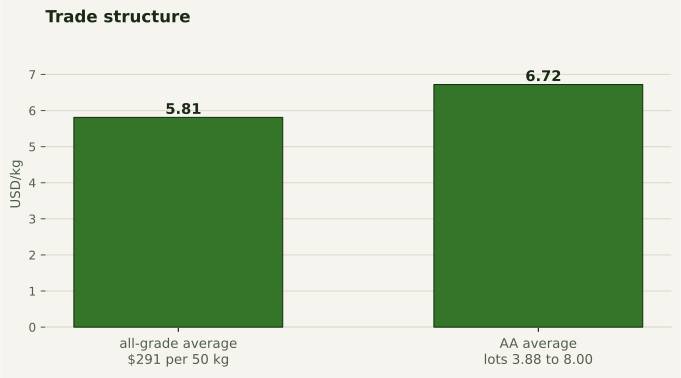
Those numbers carry two traps. The first is the unit. Results are in dollars per kilogram and per 50 kg bag. Export contracts are written in 60 kg bags, FOB Mombasa. An auction average is what the room paid for coffee in the warehouse. It is not a FOB price, not a landed price and not any exporter's offer. Milling, bagging, finance, transport and margin sit in the gap, and the exchange records none of them. The second is the calendar. Kenya has two harvests: main crop October to December and fly crop around April to June. The exchange numbers sales from the start of its own season. A date on a lot does not say which crop it is. The outturn and the society's delivery period do.
One benchmark in the sources helps with plausibility, not pricing. FAO reports Kenya's Commissioner for Cooperatives, David Obonyo, saying Kenyan coffee fetches up to 40 percent above the international average for Arabica. He gives quality, altitude and soil as the reasons. That is a ceiling claim from an official. It is not a measured differential. The best Kenyan lots sell at differentials to New York C that can be a multiple of the terminal price. Used carefully, it tells a buyer this: an offer far below the AA range above deserves a question about grade and cup. An offer far above it deserves a question about the cup score and the custody chain that justifies it.
Direct sale, the exporter and the road to Mombasa
A direct-sale route runs alongside the weekly auction. On it, an exporter and a buyer agree terms bilaterally. The sources in the fact bank describe the auction and its settlement in detail. They say almost nothing about how the direct route is administered, and this section will not pretend otherwise. Structurally, one thing follows. On the direct route, the exchange's clearing safeguards do not sit between buyer and seller. The risk sits with the exporter's contract, its AFA licence and its own relationships with factories. A direct-sale offer should always state which route the lot came through. BGI does that for every lot it quotes.
An exporter is the last Kenyan hand on the coffee and the first the buyer faces. They reconcile the outturn number against the warehouse paper. If the lot was bought in parchment, they arrange milling. They bag the coffee in 60 kg sacks and contract FOB Mombasa. A 20 ft container carries 300 to 320 bags, 18.0 to 19.2 tonnes. A 40 ft container is weight-limited to about 440 bags or 26.5 tonnes, never the 640 its volume suggests. Transit to Northern Europe runs roughly four to six weeks. A firm quote names the lot, the differential to New York C and a validity window. That is not how Kenyan coffee is sold. A supplier offering a standing price list is not quoting a lot.
An exporter is worth more to a buyer when its relationships reach further back up the chain. BGI buys directly in Nyeri, Kirinyaga, Embu, Kiambu and Trans-Nzoia. There it works with cooperative societies and factories, and buyers speak to Salome Bisau directly in English, Swahili or French. The county names matter because an exporter that can name the society and the factory, and tell you whether the lot was bought in the room or contracted directly, gives you the two facts a warehouse receipt alone does not. The guide to buying Kenyan green coffee sets out what a container quote contains.
What a buyer can actually prove, and where the proof is being built
Origin proof is now a regulatory demand, not a reputational one. The exchange's note on risk trends facing micro roasters observes that new regulations in key markets, especially the European Union, require proof of sustainable and deforestation-free supply chains. That demands investment in record-keeping, traceability systems and supplier coordination. The note also says most Kenyan coffee moves through traditional marketing channels, and that transport and processing inefficiencies raise the risk of quality deterioration before roasting. Both observations point to the same weak link: the step between factory and mill, where custody changes and the paper is thinnest.
Some proof is being built below the level of national rules. FAO reports that Nandi County is supporting coffee farmers organised in 95 cooperatives and developing a coffee traceability system meant to improve market access and income. Stakeholders at the FAO and UNIDO meeting also proposed a Kenya Coffee Flavor Map by international Q-Graders. It would give buyers region-specific flavour information for quality-based pricing. Neither exists as a national system yet. A buyer who needs deforestation-free evidence for a Kenyan lot should expect to assemble it from society records, factory delivery registers and county systems where they exist. They should not expect a single national certificate. No source here describes one.
Varietal identity is a smaller part of the same problem. World Coffee Research's country page for Kenya records collaboration with KALRO's Coffee Research Institute since 2014 and genetic purity assessments of Kenyan seed lots from 2021 to 2024. It also records the ICO estimate that by 2019 around 300,000 families had replanted with the disease-resistant Batian and Ruiru 11. A factory day lot can therefore mix SL28, SL34 and Ruiru 11 from different members' plots. A variety claim on a cooperative lot then describes the dominant planting around the factory, not a sorted product. An honest Kenyan traceability statement is short: this factory, this society, this county, this outturn, this route to the exporter. Anything beyond that comes with a document, or it does not come.