Two words, one tank and a soak
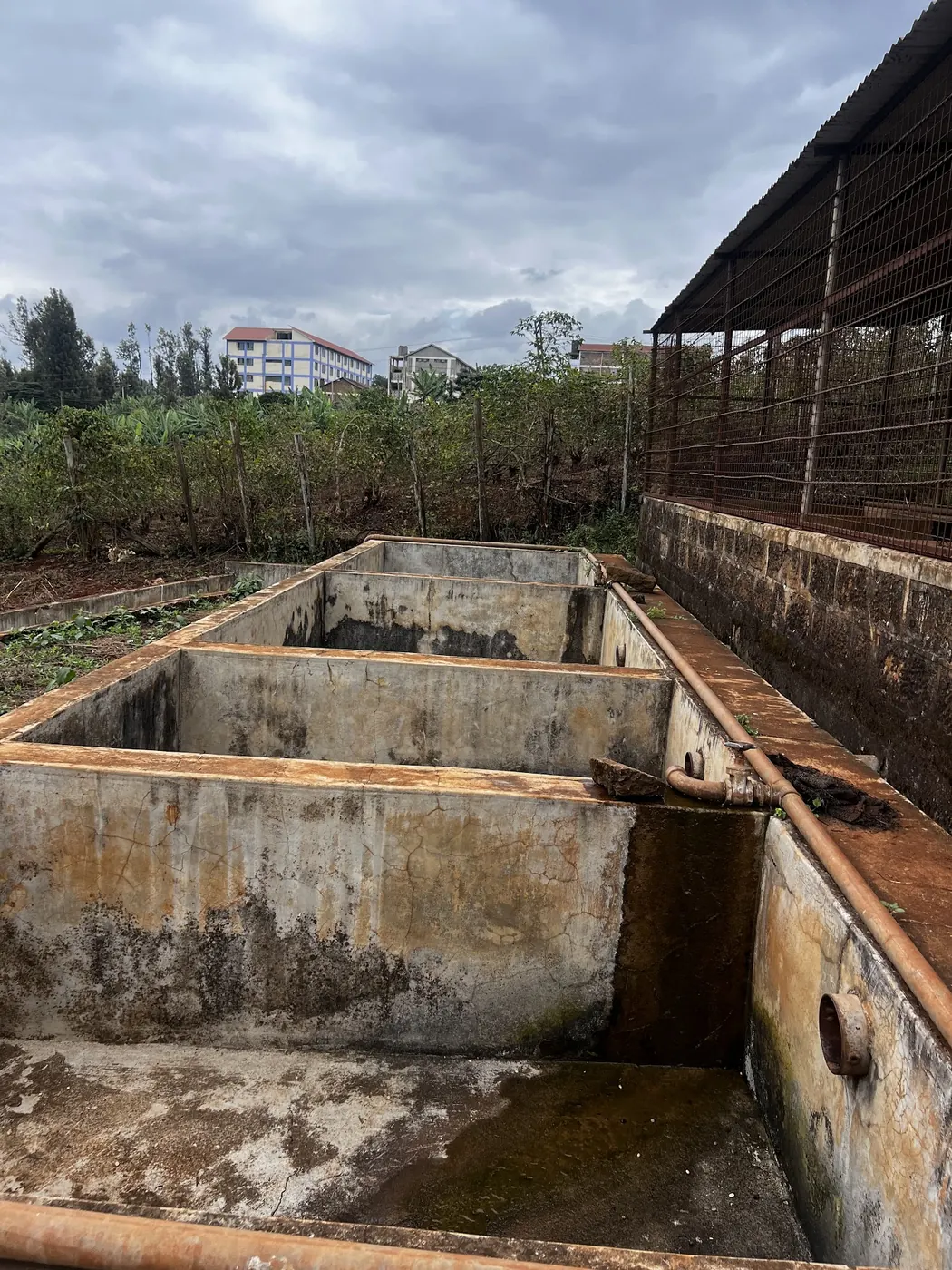
Offer sheets for Kenyan coffee all say double fermented. Most buyers take that to mean two separate fermentation cycles. The sources do not quite support that. On this site, processing is described this way: cherry is pulped the evening it is delivered, fermented overnight, then either fermented a second time or given a long clean-water soak before grading and drying. The FAO manual on post-harvest handling in Kenya, written for the cooperative sector, describes something narrower still. It sets out a single fermentation of one to four days depending on prevailing weather, followed by soaking, defined as complete immersion of parchment under water. Whether that second stage gets called a fermentation or a soak depends on who is describing it and how long the parchment sits in the water. In the trade, one name covers both.
Two things follow from that. If a buyer writes two distinct fermentation cycles into a specification, they are asking for something no factory records. The spec gets signed and ignored. The double process is not a given for every lot either. According to the Perfect Daily Grind account of how Kenyan washing stations operate, some modern factories have invested in eco-pulpers with in-built demucilagers. With those, the parchment needs no further fermentation at all, which cuts processing time, cost and water use. That lot is still washed Kenyan coffee, and it still sells as AA or AB at the mill. It never saw the tank. Station equipment is a lot-level variable, and the grade letter will never tell you which kind of station a lot came from.
Delivery day: the poster, the slip and the hopper
In Kenya a factory is a cooperative wet mill, the pulping unit owned by a farmer society. Almost all cherry in the country goes to one. The exceptions are large estates with their own wet mills and a few individual producers with pulping machines. Each station sets the dates and times on which farmers may deliver, and it publishes them on posters or bulletin boards in local shops. Picking is timed to the factory's calendar rather than the tree's. At the gate, officials sort the cherry mainly to remove stones and sticks, then another official weighs it and records the weight on a slip. Some stations now use digital scales that print the slip automatically. That slip is the farmer's only claim on the money. Payment comes once a year, not at delivery.
In the FAO manual's account, a second sorting before pulping removes immature, diseased, insect-damaged and dry berries along with leaves and twigs. How well that happens is a matter of staffing and daylight. After weighing, the cherry goes into hoppers. There, fruit from several farms is combined for the first time, and in peak season pulping can run for days at a time. Pooling happens before the pulper by design. That is why a Kenyan lot is traceable to a factory and not to a farm: an AA lot is usually the combined output of hundreds of smallholdings around one station. A buyer cannot go around the system either. Buying parchment directly from farmers is illegal in Kenya; individuals may only buy through co-operatives. Once cherry crosses the gate, the farmer's part ends. Every quality decision from here onward belongs to the station's employees.
Disk pulpers, the re-passer and the first grading nobody sees
Every station needs a pulper, fermentation tanks and somewhere to store parchment, however remote it is. Beyond that, equipment ranges widely. Many stations still run traditional disk pulpers. They are reliable, but long in service and in need of more maintenance. Water is the other fixed constraint. Many factories were built on river banks so that pulping and washing water is on hand. Stations on difficult ground have had to invest in pumps and large storage tanks. A station that pumps its water has a reason to economise on it, and the soak is the stage that uses the most.
Right after the pulper comes a grading step most buyers never hear about. Coffee is separated by density and size into three grades, called 1, 2 and lights. Grade 1 goes to the fermentation tanks. Grades 2 and lights are re-passed through a smaller pulper called a re-passer. That re-passer deals with cherry the main disks left un-pulped or half-pulped. This is the first of three density separations the coffee will see before it is a green bean, and it catches the worst of the under-ripe fruit. It has nothing to do with the AA, AB or PB a buyer sees later. Those are screen grades assigned at the dry mill, as the Nairobi Coffee Exchange's origin page sets out. A worn disk that nips beans makes broken parchment, and broken beans end up in the T fraction at the mill, the lowest-priced washed grade on the exchange.
One to four days in a black-painted tank, judged by hand
Fermentation exists to loosen the mucilage so it can be washed off. Duration is one to four days depending on prevailing weather, and the FAO manual gives an end test: wash a little parchment in clean water and feel it. A gritty feel means fermentation is complete. No instrument appears in that description. There is a concrete tank painted with acid-resistant black paint, and a person pressing wet parchment between their fingers to decide when to drain it. In a warm week the tank finishes early. In a cold wet week it runs long. Two lots from the same factory, pulped a fortnight apart, can have spent very different times in the tank. The outturn number that follows the coffee to the auction catalogue records neither.
Here the governance question turns into a cup question. A co-operative society owns the station, but the Perfect Daily Grind account is blunt: members rarely oversee activity there. The society acts as a guide, and final decisions lie with factory employees. A typical management team is a factory manager, treasurer, chairman, secretary and support staff, with the manager, treasurer and chairman often re-elected every few years. Whoever judges the tank is on that staff. A buyer assessing whether a factory's lots will be consistent from one season to the next should ask about the manager's tenure and the equipment, not read the society's constitution. Under-fermented parchment carries mucilage into the soak and onto the beds. Over-fermented parchment is where the sour and ferment taints that liquorers mark down begin. Neither shows in a green sample. Both are tasted in the cup, which is why Kenyan coffee sells off a sample and a score, never off a grade letter alone.
The soak: about 12 hours, and what the Kenyan trials showed
After the tank drains, the parchment goes back under water. The FAO manual defines soaking as complete immersion, and it reports that Kenyan studies found soaking parchment for about 12 hours after fermentation improved both colour and taste. That one sentence is the entire documentary basis for the second half of double fermented and soaked. Notice what it does not say. There are no cupping points, no score difference, no breakdown by variety or altitude, and no claim that a longer soak does more. In Kenyan trials, about 12 hours improved colour and taste. A buyer should take it exactly that far.
Two points are worth stating plainly. First, the trial is Kenyan, and that is rare and valuable. Most fermentation research comes from Latin America and has to be carried over to SL28 at altitude. This trial measured the parchment a buyer actually contracts. Second, the soak often gets credit for the whole Kenyan profile. That is over-reach. Blackcurrant is largely an SL28 trait, not a processing effect. The soak is a cleanliness step, and the colour improvement the manual records is what a buyer sees as the bluish-green of well-handled Kenyan parchment. A clean soak lets the variety show. It does not create what the variety lacks.
No public Kenyan table connects soak hours to cup score. That gap matters more than any confident summary. A roaster who cares has one route: ask the exporter which factories soak, for roughly how long, and cup those lots side by side against the same grade from a station known to run an eco-pulper and skip the tank. Score both on the usual 100-point sheet. Note the factory, the grade and the sale, and keep the sheet. After a season the roaster holds a table nobody else has, because nobody else has built it. Water is the cost side of the soak. A station pumping from a reservoir pays for every hour the parchment sits immersed. That is one plain reason the practice is not uniform.
Washing channels grade by density, not by screen
At the end of the soak, workers push the parchment through concrete channels with wooden paddles, against a stream of clean water. The channels are painted with the same acid-resistant black paint as the tanks. The parchment is washed thoroughly. The FAO manual notes that the coffee is graded again during this final washing. Heavy, dense parchment behaves differently against the current than light parchment and floaters, so the channel pulls the fractions apart. This is what the trade means by graded by density in water channels, the second of the three density separations. The third is the density table at the dry mill, which produces the TT fraction of lighter beans.
Be precise about where the buyer-visible grade is created. A great deal of origin copy gets it wrong. Channels sort parchment by weight and size at the factory. AA, AB, PB and C are assigned at the mill by screen size, defect count and quality. The exchange accepts only lots that meet the required grade and quality for sale. Screen 18 is 7.2 mm; screen 15 is 6.0 mm. The full sieve table sits in the grades post on this site, which also makes the point that a good AB routinely cups above a mediocre AA and sells for less. The channel's work for the buyer sits upstream of all that. It removes light, under-ripe and hollow parchment. Otherwise that material would dry alongside sound beans and turn up at the mill as defects, dragging down the whole lot's quality assessment rather than just its screen split. A factory with a short channel, or too little water to run a proper stream, sends more of that material forward. The mill will separate some of it. The cupper will find the rest.
Fourteen days on wire mesh, covered from 10.30 to 3.00
On the FAO manual's figures, freshly pulped coffee sits at about 55 percent moisture and must come down to 11 percent for storage, hulling and roasting. In Kenya, sun does almost all of that work, mainly at co-operative stations. Parchment is spread on wire mesh tables for about 14 days and covered with polythene sheets when it rains. Every stage of that fortnight carries its own defect risk. On the day of final washing, spread the parchment in layers no deeper than 0.5 inches. Turn it often to shed surface water and the water sitting between parchment and bean. That first stage should finish the same day. Leave it thick and wet overnight, and the mould and ferment risk the tank avoided returns on the bed.
Next comes a slow middle stage, and it is slow on purpose. While the parchment is still white, discoloured and broken beans are easy to see, and workers pick them out by hand as they stir the beds. On very hot days the coffee is covered from 10.30 a.m. to 3.00 p.m. to stop the parchment cover cracking. A cracked hull exposes the bean, and that is where the brown and faded beans in a sample often start. Eventually the parchment turns its final black colour. Here the manual makes a claim a buyer should hold at arm's length: Kenya recommends sun drying only, with full exposure for 48 to 50 hours at the final stage, because coffee is said to be photosensitive and sunlight gives it preferred quality characteristics. Mechanical drying is discouraged. Treat that as documented Kenyan practice rather than settled chemistry. The last line is uncontroversial: at the hard dark stage the parchment can be dried rapidly without quality loss, and then it goes into conditioning bins to even out moisture before transport. Drying is the most tightly specified step in the whole Kenyan manual, and the one most exposed to weather, labour and the state of the beds. A buyer who finds faded or cracked beans in a Kenyan sample is almost always looking at a drying failure, not a fermentation one. Ask about the beds before you ask about the tank.
Rotten beds and guarded stores: where price swings turn physical
All washing stations have drying beds, but many sit abandoned. The Perfect Daily Grind account reports that fluctuating prices and falling Kenyan production are the reason. Remaining beds are often wooden. Wood in a wet highland valley rots and feeds termites, which is why some stations have moved to metal frames. A station with fewer usable beds than its peak-day intake has one option: spread the parchment deeper than the half-inch the manual specifies. That slows drying and raises mould risk at exactly the stage the manual wants kept thin and turned. Price volatility does not stay on the exchange. By the Nairobi Coffee Exchange's own results, across twelve sales from 28 July to 13 October 2026, the market-total average ran from 7.15 dollars per kilogram on 11 August down to 5.81 on 13 October. A factory manager planning bed repairs on that income has reason to defer them.
Security is the other physical concern. At most stations, parchment sits in conditioning bins inside big store rooms until the moisture settles, and those stores are guarded. If parchment goes missing or gets stolen, the farmers named on the slips don't get paid. Storage before hulling is a short window: a well-built store with good air circulation, sacks stacked on wooden pallets 0.5 metres off the floor and 0.5 metres clear of the walls, for at most six months. A hulling plant costs more than a co-operative can carry, so private companies in central locations do the hulling for a fee. Only at that mill does the parchment turn into the AA or AB a buyer sees in a catalogue.
What the exchange paid for density, and what to ask a station
What all of this is worth shows up in the exchange's own numbers. Those are market totals, not any exporter's price. At sale 2 on 13 October 2026 at the Nairobi Coffee Exchange, AA averaged 6.72 dollars per kilogram and AB 6.45. TT, the lighter beans the density table sorts out, averaged 4.76. T, the smallest fraction including broken beans, averaged 3.48. AA minus TT is 6.72 less 4.76, which comes to 1.96 dollars per kilogram. AA minus T is 3.24. That is the price the market put on density and breakage, the two things the pulper, the channels and the beds either protect or waste. MH, which is mbuni, whole cherry dried with no washing at all, made 4.25 across 12 percent of the bags sold. By the exchange's record, skipping the wet process entirely cost 2.47 dollars per kilogram against AA that day.
None of those averages describes a particular lot, and how an auction lot is catalogued, sampled and bid is a separate subject. What they justify is a short list of questions to put to an exporter before contracting a factory's coffee by the container, since the grade letter answers none of them. Is the station on a river or pumping its water. Disk pulper or eco-pulper, and if the latter, does the lot see a tank at all. How long has the manager been in post. Wooden beds or metal, and how many are in use against peak intake. Does the station soak after fermentation, and for roughly how long. BGI buys directly in Nyeri, Kirinyaga, Embu, Kiambu and Trans-Nzoia and holds relationships with the societies and factories there, so those are questions it can answer factory by factory, and it will say which route, auction or direct sale, a lot came through. Buying Kenyan green coffee sets out how a quote is built: a named lot, a differential over New York C, a validity window, never a standing price.